HealthSurgeon - Healthy Living and Fitness - Purium Coupon
Primary Navigation Menu
Onion in Your Feet: Does It Actually Help a Cold?
Onion in Your Feet: Does It Actually Help a Cold?
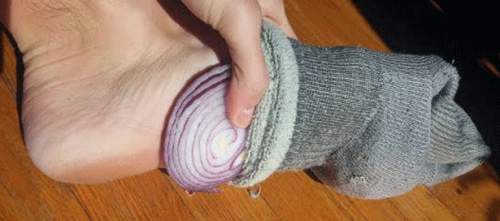
You’ve seen the clip. A slice of raw onion, tucked into a sock, overnight. By morning, the cold is gone. It makes the rounds every winter, and it does look oddly convincing.
Here’s the short version: it doesn’t work. But the onion itself isn’t a scam — the delivery method is.
The Viral Claim, Explained
The idea goes something like this: your feet have thousands of nerve endings, and somehow the onion’s sulfur compounds are “absorbed” through the skin and fight off the cold or flu. It sounds like a story someone made up over a holiday dinner, and that’s because it kind of is.
Here’s what your skin actually does. It’s a barrier. It lets water through in small amounts and absorbs certain oil-soluble compounds — that’s how some topical medications work. But meaningful quantities of onion’s active compounds? They don’t cross the skin in any dose that would affect a virus in your nasal passages, which is several centimeters of tissue away.
Nerve endings are for feeling things — pressure, temperature, pain. They’re not delivery trucks. They can’t pick up a nutrient and ship it to your immune system.
The NIH’s National Center for Complementary and Integrative Health is pretty direct about this: many popular natural remedies have little or no evidence behind them, and a remedy can be safe without being effective. An onion slice in your sock is roughly harmless — it’s not dangerous, and that’s about the highest praise it can earn.
What Onions Actually Do (When You Eat Them)
Now this part is real. Onions are one of the better sources of a few compounds people actually care about:
Quercetin — a flavonoid with anti-inflammatory properties that shows up in many plant foods.
Other flavonoids — the same family that does useful work in berries, tea, and citrus.
Vitamin C — modest amounts, but it adds up across a diet.
Sulfur compounds — the stuff that makes you cry, and also the stuff that gives onions their punch.
The Mayo Clinic points to a diet rich in vegetables — onions included — as the actual mechanism for better long-term health, not any single food acting as a cure. That’s a Mediterranean-style eating pattern, and it’s the one the evidence keeps backing.
If you want to lean into the flavonoid angle, our guide to Sugar Cravings In Children touches on how fruit and vegetable intake shapes what kids (and adults) reach for, and which swaps keep the good compounds and drop the empty sugar.
What Actually Helps When You Have a Cold
Colds are caused by viruses, and there is no food that kills a cold virus in your nose. The Mayo Clinic guidance on common colds leans on the boring stuff:
Fluids — water, broth, herbal tea. Hydration thins mucus and keeps you comfortable.
Rest — genuinely, not a suggestion. Sleep is where immune repair happens.
Honey for cough — small, consistent evidence that honey soothes a cough better than some over-the-counter syrups.
Saline nasal rinse — helps clear congestion without any drug.
If you want a supplement angle that actually has some evidence, zinc lozenges started within the first 24 hours can shave a day or two off a cold, and vitamin D keeps you from starting the season deficient in the first place. Neither is dramatic, but both are real.
A Practical Flu-Season Plan
If the onion-in-a-sock thing is your current go-to, here’s the upgrade that actually moves the needle:
Put onions and garlic in your soups, stir-fries, and broths every week. Cooked or raw, the compounds end up in your bloodstream instead of on your skin.
Keep a Mediterranean-style baseline — vegetables, legumes, olive oil, whole grains. This is the pattern the research consistently supports.
Sleep 7-9 hours most nights. This is the single most effective immune support most people can do.
Get vitamin D checked in late fall if you’re not already supplementing, especially if you live above the equator enough to not get much sun.
For a deeper look at how to build a diet that supports immunity without chasing single-ingredient cures, see our piece on Doctors Urge More Lifestyle Medicine, Fewer Pharmaceuticals — the theme is that consistent, boring habits outperform any one-time trick.
The Sleep Angle (If You’re Doing This Overnight)
If the appeal of the onion method is the “overnight” framing — you do something at night and wake up better — then the actual overnight lever you’re ignoring is sleep itself. Poor sleep is one of the most reliable ways to end up catching whatever’s going around, and improving it is harder to sell but more effective than any sock experiment. We break down the connection in Separation Anxiety and Sleep Trouble, which covers the sleep-disruption side that applies to adults just as much as it does to kids.
The onion in your feet isn’t dangerous. It’s just… not doing anything. Put the onion in the soup, keep the rest of the boring habits, and you’ll do better than the viral clip ever promised.
This website uses cookies to improve your experience. We'll assume you're ok with this, but you can opt-out if you wish.AcceptRejectRead More
Privacy & Cookies Policy
Privacy Overview
This website uses cookies to improve your experience while you navigate through the website. Out of these cookies, the cookies that are categorized as necessary are stored on your browser as they are essential for the working of basic functionalities of the website. We also use third-party cookies that help us analyze and understand how you use this website. These cookies will be stored in your browser only with your consent. You also have the option to opt-out of these cookies. But opting out of some of these cookies may have an effect on your browsing experience.